
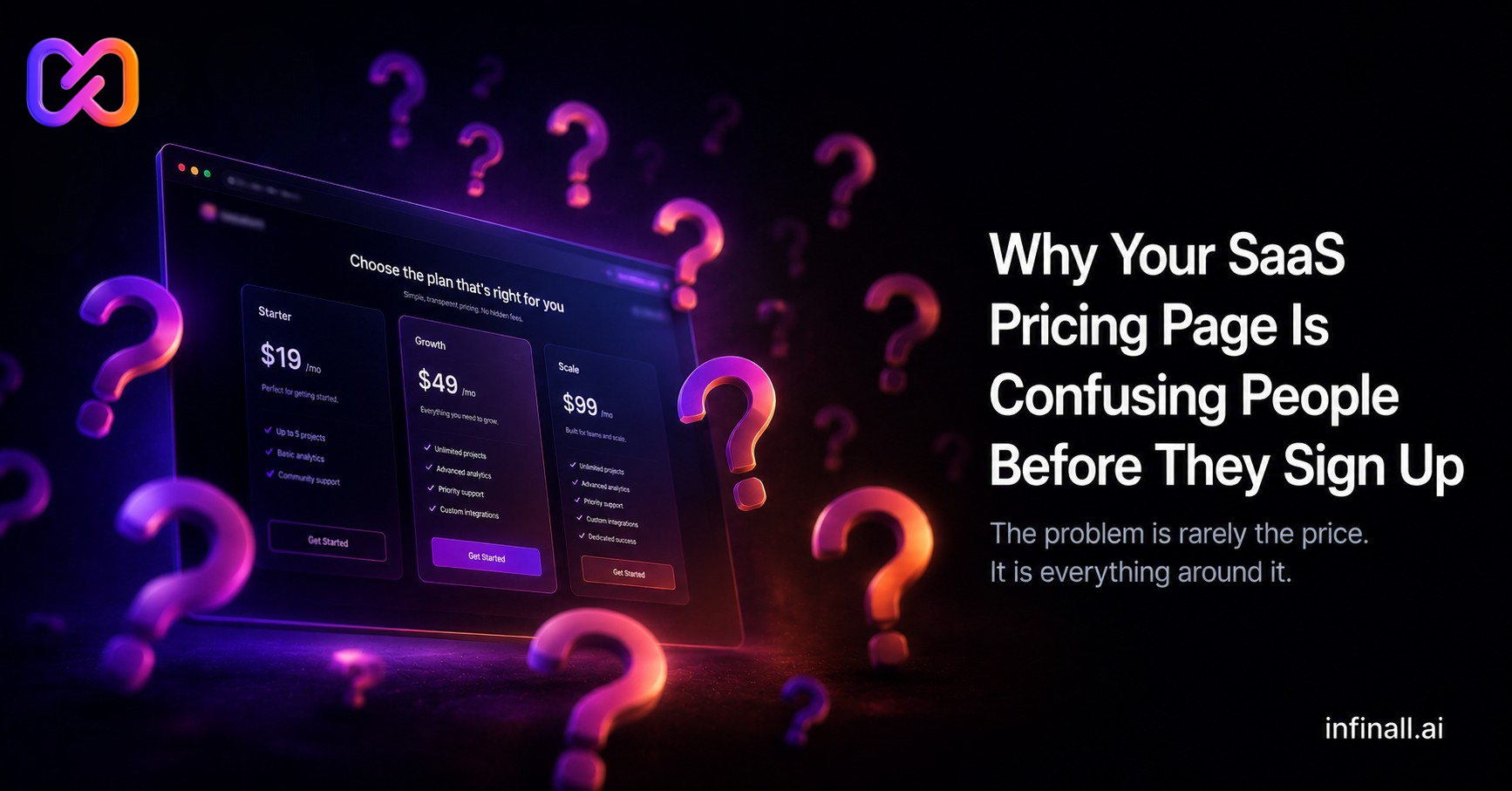
You built the product. You have a pricing page. People are visiting it.
And then they leave.
No signup. No trial start. No message asking a question. Just a session that ends somewhere on the pricing page without doing anything.
This is one of those problems that feels like it is about the price. But most of the time, it is not.
What Is Actually Happening on Your Pricing Page
A visitor lands on your pricing page with one question in their head: is this worth it for me?
That question has three parts. First: do I understand what this product does? Second: does it solve my specific problem? Third: is the price fair for the value I expect to get?
If any of those three things are unclear, the visitor leaves. Not because the price is too high. Because they could not answer the question well enough to make a decision.
Most SaaS pricing pages fail at question one or two before the visitor ever reaches the number.
The Thing Most Founders Get Wrong First
The most common mistake is treating the pricing page as a pure commercial page. A list of features, a price, a button.
But your visitor is still evaluating the product when they hit that page. They are not ready to just look at a number. They need enough context to know whether the number makes sense.
If your homepage did not do enough positioning work, your pricing page has to carry that weight. And most pricing pages are not built to do that.
The fix is not to add more copy. It is to make sure the visitor already knows exactly what your product does and who it is for before they ever reach the pricing section. That work belongs upstream.
When Your Tiers Do Not Match How Your Customer Thinks
Most early-stage SaaS products copy a three-tier pricing structure because that is what everyone else does. Starter, Pro, Enterprise. Or Basic, Growth, Scale.
The problem is that these names mean nothing to your customer. They describe your business logic, not their situation.
A founder who is just getting started does not look at a pricing page and think: I am a Starter. They look and think: which one of these is for someone like me?
If your tiers are not mapped to the actual stage or situation your customer is in, they will not know which one to pick. And when people cannot decide, they do not decide.
Try naming your tiers after the customer situation, not the product level. "Just getting started", "growing team", "doing this seriously." Not perfect examples, but closer to how your customer thinks.
The Copy Problem That Makes Every Plan Look the Same
Feature lists are the default. Every pricing page has them. The problem is that feature lists are incredibly hard to evaluate quickly.
A visitor scanning your pricing page does not know which features matter. They do not know what "unlimited projects" really means in practice or whether "advanced analytics" is the thing they actually need.
What converts better is value copy. Not what the plan includes, but what the plan enables. What is the customer able to do at this tier that they could not do before?
One line of outcome-focused copy per tier is often more convincing than eight bullet points of features.
How to Know If Your Problem Is the Price or the Explanation Around It
Before you change your prices, run this quick check.
Ask five people who represent your target customer to look at your pricing page for sixty seconds. Then ask them: what does this product do? Who is the first tier for? What would you get if you signed up today?
If they cannot answer those questions clearly, you have an explanation problem, not a price problem.
If they answer clearly but still hesitate on the number, then you have a value perception problem, which is still not really a price problem. It means the value is not landing well enough to justify the number.
Only when people fully understand the product and the value and still say the price is too high should you consider lowering it.
What to Simplify First
Fewer decisions convert better than more decisions.
If you have three tiers plus an add-on, plus a toggle for monthly versus annual, plus a currency dropdown, you have given your visitor five decisions to make before they can even click a button.
Each decision adds friction. Each friction point loses someone.
Start with one tier that is clearly right for your most common customer. Make that the obvious choice. Everything else should sit quietly beside it, not compete with it.
The One Section Most Pricing Pages Are Missing
Objections.
Your visitor has concerns. They want to know if there is a free trial. Whether they can cancel. What happens if they hit a usage limit. Whether they need a credit card upfront.
If those questions are not answered on the pricing page, the visitor has to go looking. And most of them do not. They leave.
A small FAQ section at the bottom of your pricing page that answers the three or four most common objections can recover a meaningful percentage of the people who were close to converting but needed one more piece of information.
Some founders use structured research workflows to find those objections before writing a single word. Tools like Infinall.ai help map competitor positioning and customer pain points so you know exactly what your visitor is worried about before they ever reach your pricing page.
When to Actually Change the Price
After you have fixed the explanation, the tiers, the copy, and the objections, and people still leave without converting, then it is worth looking at the number.
But at that point you have earned the right to make a real pricing decision, because you know the problem is actually the price and not everything around it.
FAQ
How many pricing tiers should a SaaS product have?
Two or three is usually enough for early-stage products. One tier keeps it simple but limits expansion revenue. Four or more creates too many decisions. Start with two, make the difference between them obvious, and add a third only when you have a clear enterprise or high-usage segment.
Why are visitors leaving my pricing page without signing up?
Usually because they could not quickly understand what the product does, which tier fits them, or whether the price makes sense for the value they expect. The problem is almost always clarity, not price.
Should I show pricing on my SaaS website or hide it?
Show it. Hiding your pricing page filters out bad fits, but it also filters out good ones who just want to know what they are getting into before investing time. For B2B SaaS under around five thousand dollars a month, showing pricing almost always converts better than hiding it.
How do I write pricing page copy that actually converts?
Focus on outcomes, not features. Instead of listing what the plan includes, tell the visitor what they will be able to do at each tier that they cannot do at the one below it. One sentence of outcome-focused copy per tier is often worth more than eight bullet points.
What is the biggest pricing page mistake early-stage SaaS founders make?
Copying a competitor's pricing structure without understanding why it works for them. Pricing is tightly connected to positioning. What works for a product with a hundred thousand users does not translate to a product with thirty. Start with your customer's situation, not your competitor's page.