
Here's something most founders figure out too late.
You have been describing your product using your words. The words you came up with while building it. The language that made sense inside your head when you were solving the problem.
Your customers describe the same problem using completely different words.
And that gap, between how you talk about what you built and how they talk about what they need, is one of the most common reasons good products struggle to grow. Not because the product is wrong. Because the language around it doesn't match how customers actually think.
Closing this gap starts with one thing: finding out what your customers actually call the problem you solve.
Why Founders and Customers Speak Different Languages
When you build a product, you go deep. You understand the technical side, the workflow, the architecture. You start using language that reflects that depth.
Your customer doesn't have that depth. They have a problem. And they describe that problem in the simplest, most direct language possible, usually the same words they'd use talking to a colleague over lunch.
If you sell a tool that helps sales teams manage pipeline, you might call it "real-time deal visibility with automated status tracking."
Your customer calls it "not having to chase my team every Monday to find out what's actually happening with our deals."
Same thing. Completely different language. And your customer's version is the one that would make them stop scrolling and pay attention.
Where Customer Language Actually Lives
The good news is you don't have to guess. Your customers are already telling you how they describe the problem. You just have to know where to look.
Support tickets and chat logs. When customers write in with problems, they use their natural language. They're not trying to impress anyone. They're just describing what's frustrating them. Go read a hundred of these and you'll start seeing patterns the same phrases, the same frustrations, the same words coming up again and again.
Sales call recordings. The first few minutes of a sales call, before you start your demo, is gold. That's when prospects describe what's going on in their own words. What made them book the call. What they've already tried. How they're feeling about the situation. Record these calls and actually go back and listen.
Customer reviews — yours and your competitors'. Go to G2, Capterra, or whatever review platform your category uses. Read the one, two, and five star reviews. Not for sentiment but for language. How do customers describe what they needed? What words do they use when they say the product solved their problem? What phrases come up when they describe the pain they had before?
Reddit and online communities. Find two or three communities where your ideal customers hang out. Search for the problem your product solves. Read the threads where people ask for help, vent about frustrations, or share what they've tried. This is some of the most honest, unfiltered customer language you'll ever find, and it's all public.
Direct customer interviews. Fifteen to twenty minutes with five or six of your best customers will give you more useful language than almost any other method. Ask them to describe what was happening before they found your product. Ask what they tried first. Ask how they would explain your product to a colleague. Record it. Transcribe it. Then read the transcripts carefully.
How to Actually Run a Customer Interview for Language
Most founders overcomplicate this. You don't need a formal research process. You just need a few good questions and the discipline to listen without correcting.
The most important rule: do not lead the witness. If you say "would you say the problem was about efficiency?" they'll agree because it sounds reasonable. Instead ask open questions and wait.
A few questions that work well:
"Before you found us, how would you have described the problem you were trying to solve?"
"If you were explaining what we do to a colleague, what would you say?"
"What were you frustrated about before you started using this?"
"What had you already tried before finding us?"
Take notes on the exact words they use. Not summaries. Not paraphrases. The actual words. "I was drowning in manual work" is different from "I had efficiency problems." One of those is messaging. The other is jargon.
The Language Gap Most Founders Don't Notice
There's a specific type of language gap that shows up constantly in early SaaS companies. The founder uses category language. The customer uses problem language.
Category language sounds like: "workflow automation platform," "pipeline management tool," "customer data infrastructure."
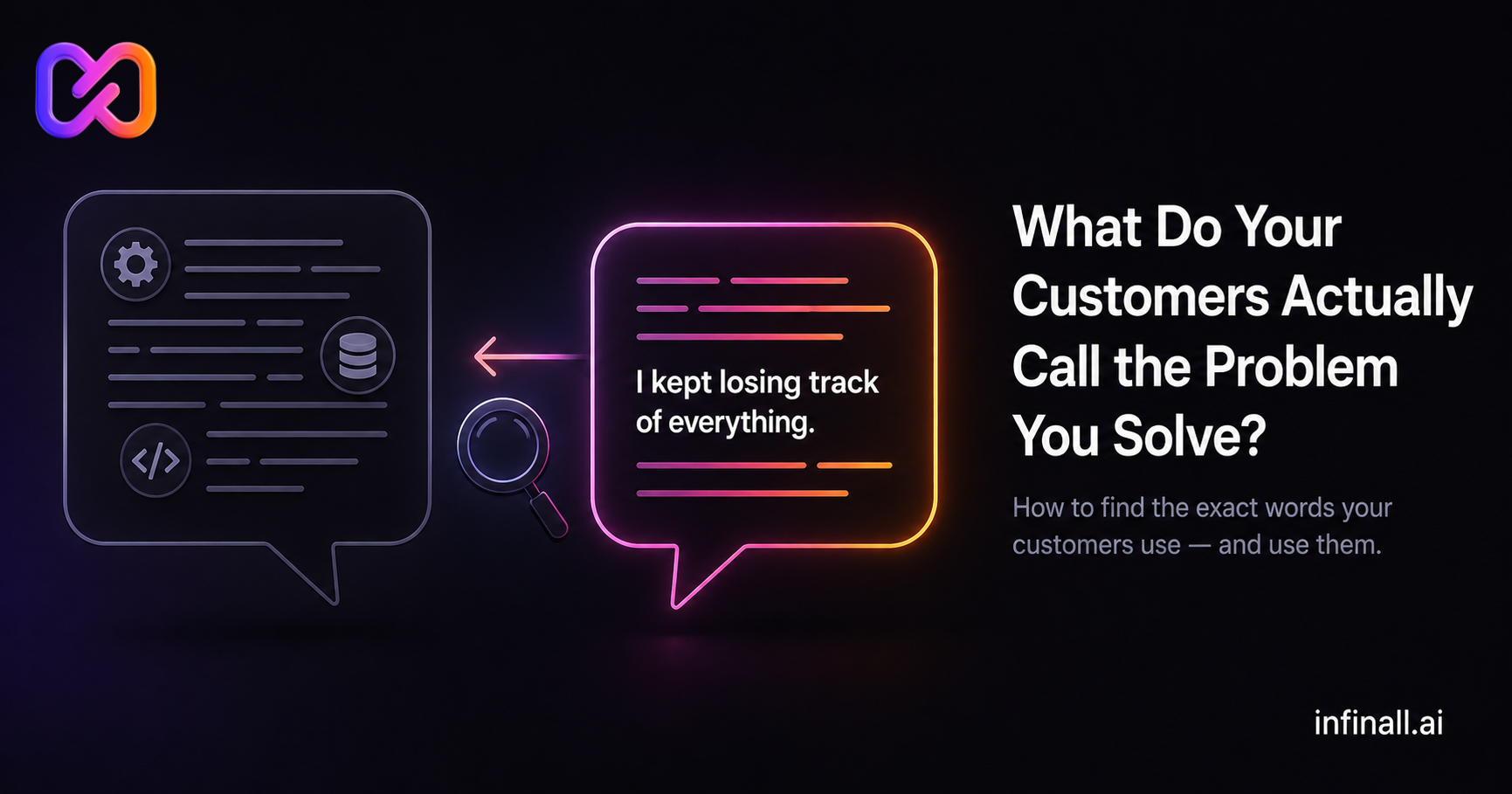
Problem language sounds like: "I kept losing track of where things were," "I had no idea which deals were actually going to close," "we had customer data everywhere and couldn't make sense of it."
When you use category language, you're describing the shelf your product sits on. When you use problem language, you're describing the moment your customer felt the pain.
Prospects respond to problem language. Because that's the language running through their head when they're searching for a solution. If your messaging matches that language, they feel immediately understood. If it doesn't, they feel like they're reading a product description for someone else's problem.
How to Extract and Use Customer Language in Your Messaging
Once you start collecting customer language, you need a way to use it.
Start simple. Create a document, a running list of real phrases from real customers. Every time you hear or read something that sounds like authentic customer language, add it. Over time this becomes one of your most valuable marketing assets.
Then start looking for patterns. Which phrases come up most often? Which descriptions match the problem your product solves most precisely? Which words feel like they were pulled directly from your ideal customer's head?
Those are the phrases that belong in your homepage headline, your email subject lines, your sales deck opening. Not because they sound clever, because they're borrowed directly from the people you're trying to reach.
When a prospect reads your homepage and sees language that sounds exactly like how they'd describe their own problem, something clicks. They don't have to translate. They don't have to figure out if this is relevant to them. They already know.
That recognition is what good messaging creates. And it always starts with listening before you write a single word.
FAQ Section
Q: How many customer interviews do I need to find useful language patterns?
Five to eight interviews with customers who match your ICP closely will usually surface the key patterns. You don't need a large sample. You're not doing quantitative research, you're looking for recurring phrases and descriptions. Once you hear the same language coming up three or four times from different people, that's signal worth using.
Q: What if my customers use very different words from each other to describe the problem?
That usually means one of two things: either your ICP is broader than you think and you're serving multiple distinct customer types, or the problem isn't well-defined yet. In both cases, go back to basics, who is your most valuable customer, and what do they specifically say? Start there before trying to synthesize language across a wide audience.
Q: Can I use competitor reviews to build my customer language library?
Absolutely. In some ways competitor reviews are even more useful than your own, because the customers writing them haven't been influenced by your framing at all. They're describing the problem in pure customer language. Read both positive and negative reviews carefully and note the specific phrases people use.
Q: How do I know which customer phrases are worth using in my messaging?
Look for phrases that are specific, emotional, and instantly recognizable. "I was drowning in spreadsheets" is better than "data management was inefficient." The more visceral and concrete the language, the more likely it is to resonate. Generic descriptions rarely make good messaging even if they're technically accurate.
Q: How often should I be doing customer language research?
It's not a one-time exercise. Customer language evolves as your product evolves, as your ICP shifts, and as the market changes. Revisit it every quarter at minimum, especially when you're entering a new segment, launching a new feature, or noticing that your messaging doesn't seem to be converting the way it used to.