
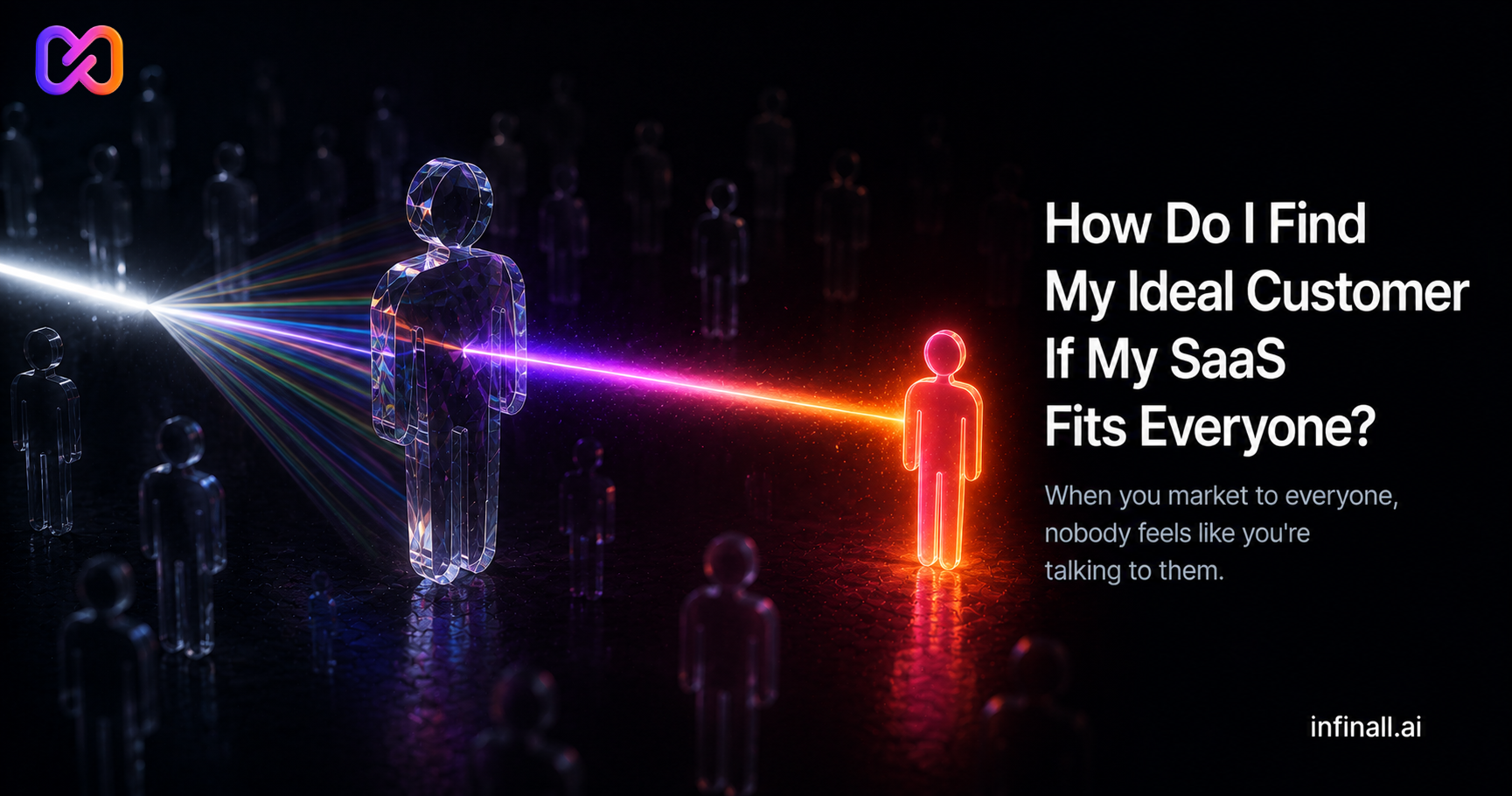
"Our tool works for anyone who needs to manage projects" sounds like a strength. It isn't.
If your ICP is "anyone," your marketing has no direction. No headline, no ad, no piece of content can speak to "anyone" and still feel specific. So it ends up speaking to no one.
This is one of the quietest reasons SaaS growth stalls. Not bad product. Not bad execution. Just a target so wide that nothing you write ever lands.
Why "Everyone" Feels True but Isn't Useful
Most tools genuinely could be used by a wide range of people. A time-tracking app could help freelancers, agencies, and enterprise teams. That's a fact about your product. It's not a marketing strategy.
The question isn't who could use your product. It's who is already getting the most value from it, and who is easiest for you to reach with the time and budget you actually have.
Look at Who's Already Paying, Not Who You Imagined
Open your customer list and sort by two things: who's been paying the longest, and who uses the product the most. That group is telling you something. They found real value, not just curiosity value.
Pull ten of those accounts. What do they have in common? Company size, role, industry, the specific task they use your tool for. Patterns here matter more than any persona template you'd fill out from imagination.
Talk to the Customers Who Almost Didn't Buy
Your best customers can tell you why they stayed. Your near-miss customers, trial users who didn't convert, can tell you who you're not for, which narrows things just as fast.
Ask five of them one question: "What made you unsure this was right for you?" Their answers usually point straight at a segment your product wasn't built for, even if it technically works.
Turn the Pattern Into One Sentence
Once you see the pattern, write it down as one sentence: "[Product] is for [specific role/industry] who need to [specific outcome] without [specific pain]." If that sentence still describes half the internet, it's not specific enough yet.
A narrower ICP doesn't shrink your market as much as founders fear. It shrinks your marketing effort, because every piece of content, every ad, every headline now has one person in mind instead of an average of everyone.
Founders often get stuck here because narrowing feels risky, like turning away customers on purpose. It's worth remembering the sentence describes who you lead with, not who you refuse to serve. Infinall.ai's research workflow is built around this exact step, pulling patterns from your existing customers and competitors so the ICP comes from evidence instead of a guess made at a whiteboard.
Stop Looking for More Customers. Look for Better Customers.
Many founders think growth comes from reaching more people. In reality, growth usually comes from understanding a smaller group of people much better.
The customers who get the most value from your product are also the ones who are easiest to market to. They already recognize the problem, understand why it matters, and are actively looking for a solution. Instead of trying to convince everyone, focus on finding more people like your best existing customers.
As your understanding of that audience improves, your messaging becomes clearer, your marketing becomes more effective, and customer acquisition becomes less expensive.
Your Ideal Customer Will Change as Your SaaS Grows
Your first customers are not always your long-term customers.
Many SaaS companies begin by serving a broad audience because they are still learning where the strongest demand exists. As more customers use the product, patterns begin to appear. Certain industries may adopt the product faster. Some company sizes may stay longer. Others may generate higher revenue or require less support.
Review your customer profile regularly. Your Ideal Customer Profile should evolve as your business grows and your understanding improves.
Build Your Marketing Around Your Best Customers
Once you've identified your ideal customer, use that knowledge everywhere.
Update your homepage with language that speaks directly to them. Create content around the questions they ask most often. Choose marketing channels where they already spend time. Even small changes become more effective when they're built around the right audience.
Marketing becomes much easier when every decision starts with a clear understanding of who you're trying to help.
FAQ
What if I have fewer than ten paying customers to study?
Study all of them, plus your last ten trial signups. Even a small sample shows patterns faster than no research at all.
Can I have more than one ICP?
You can, but market to one at a time. Splitting attention across two audiences in the same content usually weakens the message for both.
How often should I revisit my ICP?
Every three to six months, or any time you notice a new type of customer converting faster than the rest.
Can my SaaS have more than one ideal customer?
Yes, but it's usually better to focus on one primary audience first. Once your messaging and positioning are working well, you can expand into additional customer segments.
How often should I update my Ideal Customer Profile?
Review it every six to twelve months or whenever your product, market, or customer base changes significantly.
What if my current customers all use the product differently?
Look for common problems rather than identical use cases. The shared problem is often more important than how each customer uses the product.