
You built something real. You know exactly how it works. You've done the demos. You've answered the questions.
And yet, people visit, look around, and leave. Trials don't convert. Prospects go quiet after what felt like a great call.
So what's going wrong?
Most founders assume it's the product. Or the price. Or the market timing.
And the tricky part is, bad messaging doesn't feel bad when you write it. It feels totally fine. Because you understand your product perfectly. The problem is, your prospect doesn't.
Your Prospects Are Confused: And They Won't Tell You
Here's something nobody talks about enough: when someone lands on your site and doesn't get it, they don't email you asking for clarification. They just leave.
No feedback. No "hey, I couldn't figure out what you do." Just gone.
That's what makes messaging problems so hard to spot. The silence looks like disinterest. But a lot of the time, it's confusion.
If someone has to read your homepage twice to understand what you do — that's already too much work. People make up their minds in seconds. If your message doesn't click fast, they move on.
The Curse of Knowing Too Much
There's this thing called the curse of knowledge. Once you deeply understand something, it becomes almost impossible to explain it simply because you've forgotten what it felt like not to know it.
Founders often know their product so well that they accidentally explain it from their own perspective instead of the customer's.
Prospects are not understanding your product. They are trying to understand whether it solves their problem.
If your messaging makes them work too hard to figure that out, many will leave.
Generic Language Is Killing Your Message
Read these and tell me if they sound familiar:
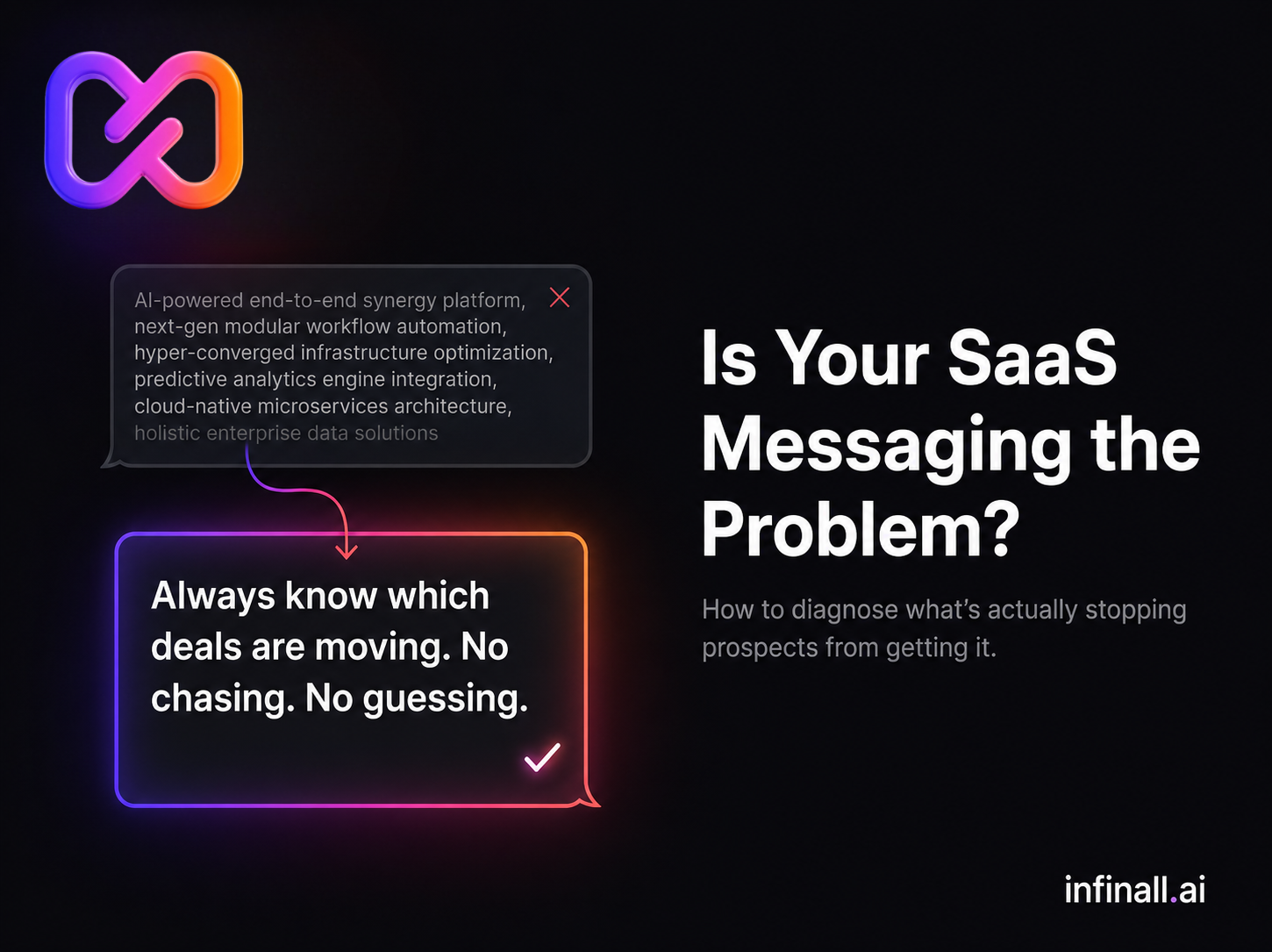
"An AI-powered, end-to-end platform that streamlines your workflow."
"The future of enterprise operations."
"Unlock your team's full potential."
These phrases are everywhere. They've been on so many SaaS homepages that they've stopped meaning anything. They sound professional, but they do not explain what makes your product relevant to a specific customer.
When your messaging could belong to literally any SaaS product, it doesn't belong to yours.
The fix isn't fancier writing. It's more specific writing. What exactly do you do? For who? And what changes for them because of it?
Features Tell. Outcomes Sell.
This is probably the most common messaging mistake in SaaS.
Founders write about what their product does. But prospects buy based on what changes for them.
There's a big difference between these two:
Feature: "Automated pipeline reporting with real-time data syncing."
Outcome: "Always know which deals are actually moving — without chasing your team for updates."
Both sentences describe the same thing. But one makes you feel something. One makes you think, yeah, that's exactly my problem.
If your homepage is mostly a list of features, you're making prospects do the translation work themselves. You're asking them to connect the dots between what your product does and why it matters to them. Most won't bother.
Write about the after. What does life look like once your product is doing its job?
If You Don't Know Your ICP, Your Messaging Will Show It
ICP stands for Ideal Customer Profile. And vague ICP = vague messaging. Every time.
A lot of founders think their ICP is something like "B2B companies, 50–200 employees, in the US." But that's not a person. That's a segment.
Your ICP is the specific human who feels the pain your product solves.Your ICP is the specific person who feels the problem most strongly and is actively looking for a better solution.
When you know that person well, what they Google at 11pm, what makes them groan in meetings, what they've already tried, your messaging writes itself. Because you're just speaking directly to them.
When you don't know them well enough, you write for everyone. And messaging that's written for everyone resonates with no one.
Are You Just Sounding Like Everyone Else?
Here's a quick gut check: could your homepage copy be pasted onto a competitor's site without anyone noticing?
If yes then that's a positioning problem.
Good positioning takes a stand. It says clearly: this is who we're for, this is the problem we solve, and this is why our approach works better than the alternative for this specific customer.
You don't have to call out competitors by name. But you do have to acknowledge that your prospect has options. And you have to give them a real reason to pick you — not a vague reason, not a generic reason, a specific one.
How to Actually Diagnose Your Messaging
Okay, so how do you know for sure if messaging is the problem? Here are some simple ways to check:
The five-second test. Show your homepage to someone who's never seen your product. After five seconds, ask them: what does this company do? If they can't answer, your messaging isn't clear enough.
The sales call audit. What are the first questions prospects ask before your demo even starts? If it's "so, wait, what exactly does this do?" that's your messaging failing before you even open your mouth.
Compare your language to your customers' language. Go pull the exact words your best customers used to describe their problem before they found you. Now read your homepage. How much overlap is there? If your site says "automated financial operations" and your customers say "I was drowning in manual work every month" you're not speaking the same language.
Talk to people who didn't buy. Ask them directly: was it clear what we do and who we help? Their answers will tell you more than any tool or metric ever will.
Ask your own team. Get five people from sales, product, support and ask each of them to describe what your product does and who it's for. If you get five different answers, your messaging isn't defined well enough internally to ever be clear externally.
Messaging Should Reflect Customer Reality
Strong messaging reflects how customers think about their problems. When there is a gap between your language and theirs, confusion follows.
The goal is not to sound smarter. The goal is to sound familiar.
Your customers are already describing their problems in the exact words that would resonate with future customers. They're saying it in sales calls, in support tickets, in reviews, in Slack messages. They're describing their frustrations, their workarounds, and their version of success.
When you use those exact words in your messaging, or something very close, something clicks. Prospects read it and think "how did they know that's exactly what I was dealing with?"
Some founders and teams use tools or even structured frameworks to collect and organize this kind of customer insight, the kind that actually shapes how you talk about your product.
FAQ Section
Q: How do I know if messaging is hurting acquisition vs. causing churn?
Messaging problems usually show up at the top, low trial signups, low demo conversions, or prospects saying "it wasn't what I expected." Churn is usually a product or onboarding issue. If people aren't getting in the door, or they feel misled after signing up, messaging is likely the culprit.
Q: What's the difference between positioning and messaging?
Positioning is the decision, who you're for, what category you're in, how you're different. Messaging is how you say that out loud. Bad messaging almost always starts with unclear positioning. Fix the positioning first, then the words get easier.
Q: How often should we revisit our messaging?
Whenever you notice patterns of confusion in sales calls. When you move into a new market. When a big competitor shows up. When your product changes significantly. At minimum, a real messaging review every 6–12 months keeps you honest.
Q: Do we need a rebrand to fix our messaging?
Almost never. Messaging is a language problem, not a logo problem. Changing how you describe outcomes, who you talk to, and what problem you name first — that's usually all it takes.
Q: How do we get the whole team on the same page?
Write a simple one-pager. Not a 40-slide brand deck, just a short document that defines your ICP, the core problem you solve, your main value prop, and the outcomes you deliver. Share it across sales, marketing, product, and support. Use it every time someone needs to explain what you do.