
Most founders get this backwards.
They pick a channel first. LinkedIn, SEO, cold email, content, doesn't matter which one. They jump in, start creating, start spending, start posting.
Then three months later nothing much has happened and they're not sure why.
The channel usually isn't the problem. The preparation before the channel is.
There's a set of things every SaaS founder needs to figure out before committing to any marketing channel. Because without them, any channel you pick will underperform.
First: Know Exactly Who You're Trying to Reach
"Small businesses" is not an ICP. "Marketing managers at B2B SaaS companies with 20 to 100 employees who are the only marketer on their team and have tried three different tools in the last year without finding one that sticks" that's an ICP.
The more specific you are, the better every marketing decision that follows becomes. Which channel to use. What to say. What problems to talk about. What tone to take.
If your ICP is vague, your messaging will be vague. If your messaging is vague, no channel will work well, because you won't know what to say when you show up.
Before you touch a channel, write down your ICP in one paragraph. Name the role. Name the company type. Name the specific situation they're in. Name what they've already tried. If you can't write that paragraph confidently, that's your first piece of work.
Second: Know What Problem You're Actually Solving
This sounds obvious. It's usually not.
Most founders know what their product does. Fewer know how to describe the problem it solves in the language their customer would use.
There's a difference between "we provide automated pipeline reporting" and "you always know exactly where every deal stands without chasing your team for updates."
One describes the product. One describes the moment the customer feels the pain.
Marketing that leads with the problem in customer language works significantly better than marketing that leads with features. But you can only do that if you've done the work of figuring out what your customer actually calls the problem, not what you call it.
Third: Understand Why People Are Actually Choosing You
If you have any existing customers, you have access to something incredibly valuable: the reason someone picked you over doing nothing or picking a competitor.
Do you know what that reason is? Not what you think it is, what they actually say when you ask them?
This is your value proposition. And it needs to be clear before you start marketing, because your marketing will constantly be communicating it, consciously or not.
If you don't know why people choose you, your marketing will guess. Sometimes it'll guess right. More often it'll emphasize things that sound good to you but don't reflect what actually matters to the customer.
Ask your existing customers directly: "What was the main reason you decided to try us?" and "What would you tell a colleague who asked why you use this?" The answers will surprise you and sharpen everything you do next.
Fourth: Know What You Want Marketing to Actually Do
This one seems too simple to mention. It's not.
Marketing can do many different things. It can create awareness. It can generate leads. It can build trust with people who aren't ready to buy yet. It can accelerate deals already in progress. It can reduce churn by educating existing customers.
Most early-stage founders want all of these things simultaneously. But different channels do different things. And if you don't know what you specifically need marketing to do right now, at this stage of your business, you'll pick channels based on what looks popular rather than what fits your actual situation.
If your problem is that people don't know you exist, awareness and discovery channels matter most. If your problem is that people know about you but aren't converting, something else is happening and adding more awareness won't fix it. Know the job you're hiring marketing to do before you pick the tool.
Fifth: Have Something Worth Sending People To
Before you invest in any channel that drives traffic or interest like content, community, outreach, partnerships, make sure that when someone follows up on that interest, what they find is clear.
This doesn't mean your website has to be perfect. It means that when someone lands on it after hearing about you, they should be able to answer three questions within ten seconds: what does this do, who is it for, and what should I do next.
If your homepage fails that test, fixing it will do more for your results than any channel you add. Driving traffic to a confusing page just means more people get confused faster.
Sixth: Decide How You'll Know If Something Is Working
Before you start, decide what signal you're looking for. Not a perfect analytics setup, just a clear answer to: "what would have to be true in 60 days for me to feel like this channel is worth continuing?"
Is it a number of signups? Demo requests? A traffic threshold? A specific amount of engagement? Write it down before you start.
Without this, you'll evaluate channels based on feeling. Feelings are unreliable. Channels that feel exciting often get more time than they deserve. Channels that feel boring but are quietly delivering results get cut too early.
Seventh: Build the Habit Before You Build the System
For most early-stage founders, marketing fails not because the strategy is wrong but because the execution is inconsistent.
You post three times, nothing happens, you stop. You write two blog posts, they don't rank immediately, you stop. You do one week of outreach, it feels awkward, you stop.
Marketing builds through consistency over time. The founders who see results aren't usually doing something smarter, they're just doing it longer.
Before you pick a channel, be honest with yourself about what you can sustain for 90 days without quitting. That constraint should inform which channel you pick. A channel you'll actually do consistently will outperform a channel you'll abandon after two weeks every single time.
The Checklist in Short
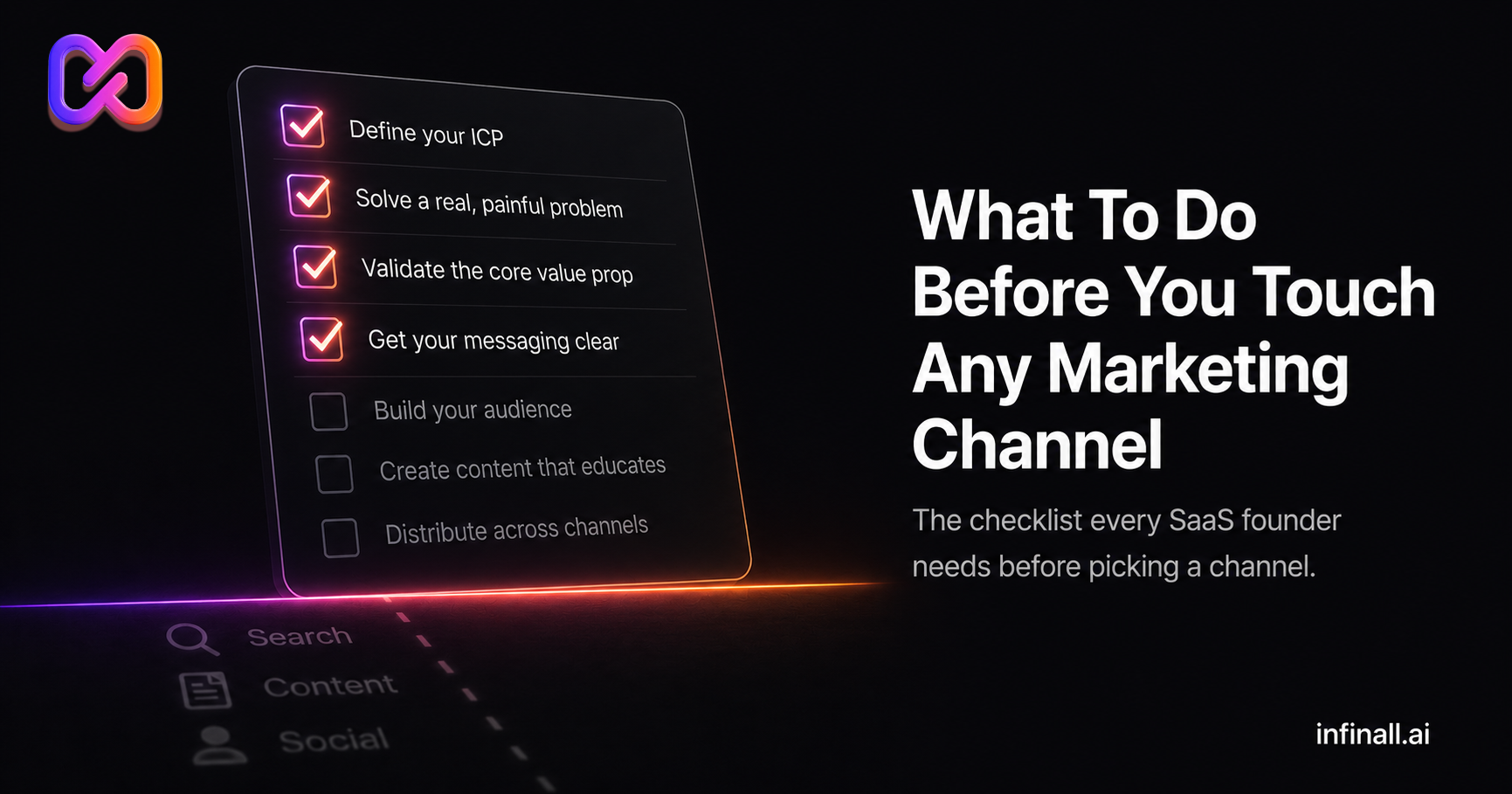
Before you touch any marketing channel, make sure you can answer yes to these:
Do I know specifically who I'm trying to reach and can I describe them in a paragraph?
Do I know how my customer describes the problem in their own words?
Do I know why existing customers chose me over the alternatives?
Do I know what specific job I need marketing to do right now?
Does what I'm sending people to clearly explain what I do and who it's for?
Do I know what signal I'm looking for in the next 60 days?
Can I sustain this channel consistently for at least 90 days?
If you can answer yes to all seven, you're ready. If not, the time you spend answering those questions will pay back more than any channel you could launch today.
FAQ Section
Q: How long should the preparation phase take before I start a marketing channel?
Two to three weeks of focused work is usually enough for most early-stage founders. That means customer conversations, ICP definition, a clear value proposition, and a basic measurement plan. You don't need months of strategy before taking action, you just need enough clarity to make the first 90 days of execution useful rather than random.
Q: What if I've already started marketing but haven't done this preparation?
Pause and do it now. It's not too late. Going back to the foundations mid-execution is uncomfortable but far less expensive than continuing to invest in channels without a clear foundation. Most founders who do this find that they were either talking to the wrong people, saying the wrong things, or both and fixing that changes results quickly.
Q: Do I need to finish all seven checklist items before starting?
Ideally yes, but in practice the most critical ones are knowing your ICP, understanding your customer's language, and knowing what you want marketing to do. If you're solid on those three, you can start and build the rest as you go. The checklist is a guide, not a gate.
Q: What's the most common mistake founders make before starting marketing?
Skipping the customer conversations. Most founders think they know their ICP and their customer's language well enough already. They're usually wrong in ways that matter. Five honest conversations with real customers or prospects will surface assumptions you didn't know you were making, and changing those assumptions changes everything downstream.
Q: How do I pick the right first marketing channel once I've done the preparation?
Go where your ICP already spends time and where you can show up consistently. If your customers are active on LinkedIn and you can write well, start there. If they hang out in Slack communities, start there. The best first channel is the one where your ideal customer already is and where you can sustain consistent effort for at least 90 days.