
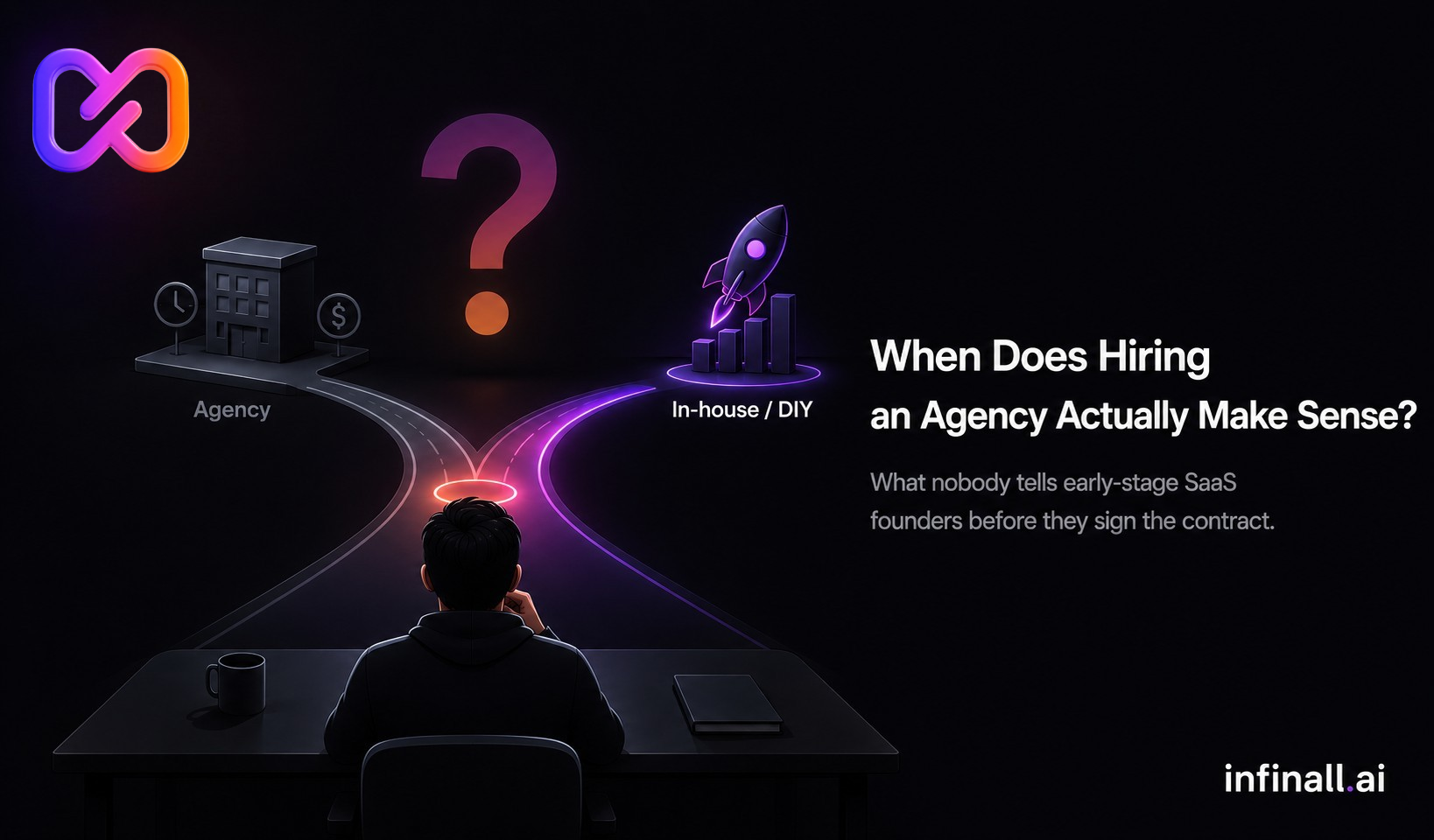
At some point almost every funded SaaS founder asks this question.
The product is built. You have runway. Marketing needs to happen but you do not have a team. Hiring an agency feels like the logical move. They are the experts. You hand it over and focus on building.
Except it rarely works that cleanly. Not at the early stage. Not for most SaaS startups.
This is not an article that says agencies are bad. Some do excellent work. But there is a right time to bring one in and a wrong time. For most seed and pre-seed founders, timing matters far more than which agency you choose.
What an Agency Actually Does vs What Most Founders Think They Do
Here is the assumption most founders make going in: the agency will figure out the marketing. They will study the product, find the right audience, build the strategy, and run campaigns that bring in leads.
That is not what most agencies do. Especially not at the early stage.
Agencies are good at execution. Producing content, running ad accounts, managing campaigns, delivering the outputs in their contract.
What most agencies are not good at, and what most of them will not tell you upfront, is building your positioning from scratch.
Positioning is the work that has to happen before execution. Who is this product for? What specific problem does it solve better than doing nothing? Why would someone choose it today?
Those are founder questions. They require someone who knows the product deeply, has spoken to real users, and understands the market from the inside.
When a founder hires an agency before that work is done, the agency guesses. They produce content and campaigns based on their interpretation of what the product does. Sometimes they get close. Often they do not. And the founder ends up reviewing outputs that feel slightly off, giving vague feedback, and watching the retainer disappear into work that does not convert anyone.
The Stage Question: Are You Ready to Hand Off Marketing Right Now?
There is a readiness question most founders skip when evaluating agencies. It is not "can I afford this?" It is "do I know enough about my own marketing to actually direct this agency?"
Agencies need direction. They need to know who to target, what message to lead with, which channel to prioritise, and what success looks like. If you cannot answer those clearly, you cannot direct an agency effectively. You will end up in weekly calls where everyone is making educated guesses, and the invoices keep arriving.
Before hiring any outside marketing help, you should be able to answer four things without hesitation.
Who is the specific person most likely to buy this right now? Not a general description. One specific type of person with one specific problem.
What do you say to that person that makes them want to try the product? What is the one message that consistently gets a positive response?
Which single channel is most likely to reach them? Not all channels. Just the one that makes the most sense given where that type of person spends time.
What does a good result look like in ninety days? Something specific and measurable, not just "more growth."
If any of those four answers is "we are still figuring that out," the agency is not the right next step yet. The research is.
What You Lose When You Hire Before Your Positioning Is Solid
When positioning is unclear going into an agency engagement, something predictable happens.
The agency produces work that is technically competent but strategically vague. Blog posts that could apply to any SaaS product. Ads that speak to a wide audience instead of a specific one. Campaigns that get impressions and clicks but not signups.
The founder looks at the results and concludes that marketing does not work. But marketing is not the problem. The problem is that nobody agreed on what the message was before the campaigns started.
This is one of the most expensive mistakes at the early stage. Not just because retainer fees add up. But because three months of misaligned campaigns is three months of not learning what actually resonates with real buyers.
The founders who get real results from agencies are almost always the ones who already had clarity before the engagement started. They knew their ICP. They had a message that was already converting at some level. They needed help scaling what was already working, not figuring out what might work.
The Three Questions to Answer Before Signing Any Agency Contract
These are not questions about deliverables or pricing. They are questions that tell you whether an agency engagement makes sense right now.
One: what will the agency do in the first thirty days? If the answer is mostly setup, discovery workshops, and strategy documents, you are paying for things you could work out yourself. A good agency should be able to name specific outputs and tests they will run in the first month.
Two: how will we measure whether this is working? If the metrics they propose are impressions, follower counts, or content volume, push back. For a SaaS startup, the only metrics that matter at this stage are signups, trials, and conversations with real prospects. If the agency cannot connect their work to those outcomes, that is a problem worth naming before you sign.
Three: what do you need from us to do this well? This question reveals what the agency actually requires to succeed. If they need detailed ICP documentation, tested messaging, and existing customer insights, and you do not have those yet, they are indirectly telling you that you are not ready to hand this off.
When an Agency Is Genuinely the Right Next Step
There are real situations where bringing in an agency makes sense.
You have early customers and you understand clearly why they chose your product over doing nothing. You have a message that is converting, even at a small scale. You need to reach more of those people but do not have the capacity to do it yourself.
You need one specific capability you cannot build quickly. Paid search management or video production for example. A specialist agency focused on one channel often makes far more sense than a generalist agency trying to cover everything at once.
You are preparing for a funding round and need to demonstrate that marketing can generate pipeline. You already have the strategy. You need execution speed.
In all of these situations the common thread is the same. The founder has clarity before the agency arrives. The agency is amplifying something that already works. Not starting from zero and billing hourly to figure it out.
When It Isn't: And What Makes More Sense at Your Stage
If you are pre-seed or early seed with fewer than a hundred customers and you are still working out who your best customer actually is, an agency is almost certainly not the right investment right now.
What makes more sense at that stage is building the foundation yourself first.
That means talking to your existing users and understanding specifically why they chose your product. It means finding the language they use to describe their problem before they found you. It means identifying which one channel brings in the most relevant visitors and going deep on that before spreading across five others.
This work is not glamorous. It takes time. But it is what makes everything that comes after more effective.
What to Build Before You Bring in Any Outside Marketing Help
Before signing with any agency, make sure you can answer these clearly.
You know your best customer and can describe them in one specific sentence. You have a message that gets a positive reaction when you share it with real prospects. You have a sense of which channel your target user is most reachable on. You have a measurable definition of what marketing success looks like in the next ninety days.
With those four things in place, an agency can do useful work for you. Without them, you are paying someone to make assumptions on your behalf.
At seed stage, that is a very expensive way to learn something you could have figured out in a few customer conversations.
FAQ SECTION
How much does a marketing agency cost for a SaaS startup?
Full-service agency retainers typically range from a few thousand to tens of thousands per month depending on scope and experience level. Specialist agencies focused on one channel tend to cost less. The more important question at early stage is not the monthly cost but what specific outcomes you can measure and attribute within the first ninety days.
What should I have in place before hiring a marketing agency?
At minimum you need a clear description of your target customer, a message that has gotten genuine positive reactions from real prospects, a sense of which channel that audience uses most, and a measurable definition of success. An agency given those inputs can do useful work. Without them they are working in the dark on your budget.
What are the signs I hired a marketing agency too early?
The clearest sign is when your weekly agency calls feel more like strategy discussions than execution updates. If you are still figuring out who to target and what to say on calls that are billed at agency rates, the foundational work was not done before the engagement started. Another sign is deliverables that feel generic, content that could describe any SaaS product rather than yours specifically.
How do I keep visibility into what an agency is doing with my budget?
Before signing, agree on a small number of metrics tied to real business outcomes, signups, trials, qualified conversations. Ask for weekly reporting against those metrics rather than vanity numbers like impressions or reach. Build in a review step where you see outputs before they go live, at least in the early months. Visibility into what is being produced and why should be part of the contract, not something you have to ask for later.
What is the difference between a marketing agency and a fractional CMO for a SaaS startup?
An agency executes campaigns and produces content. A fractional CMO thinks strategically about positioning, channels, and marketing decisions, usually working part-time embedded in your company. For early-stage founders who need strategic direction but cannot afford a full-time hire, a fractional CMO often makes more sense than a full-service agency. The right choice depends on whether you need more strategic clarity or more execution capacity.