
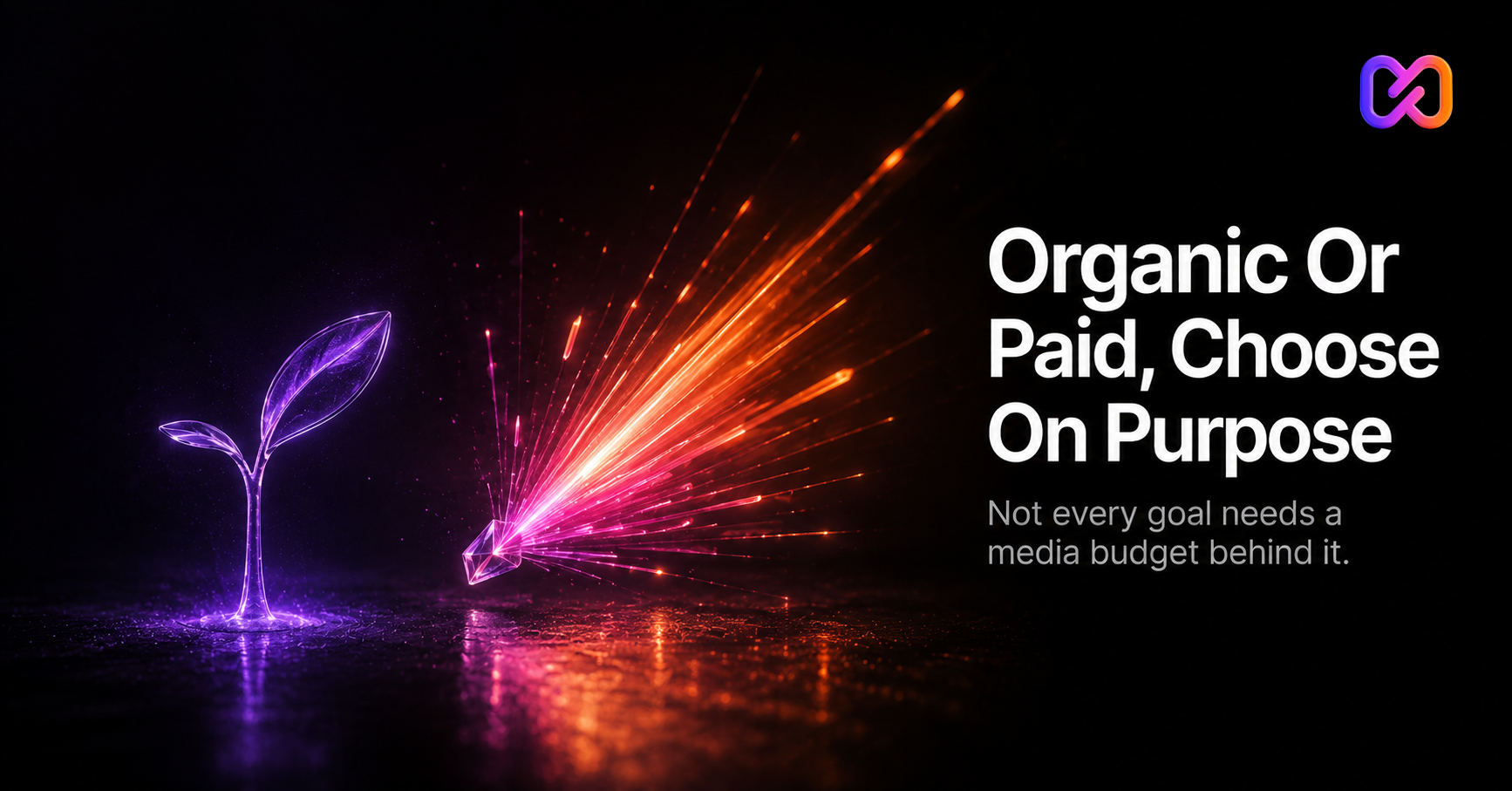
Paid media tends to be the default answer for almost any campaign goal, mostly because it feels more controllable and more measurable than organic. But there's a real category of goals where organic social genuinely performs better, and treating every campaign as a paid campaign by default means missing that.
The goal matters more than the format
Paid spend buys reach and speed. It doesn't buy trust on its own. For goals that depend on trust, thought leadership, building a reputation in a specific niche, or slowly warming up an audience that isn't ready to buy yet, organic social often does the job more naturally than an ad ever could.
Organic works well when the message needs credibility, not volume
A paid ad announcing a bold claim reads differently than the same claim showing up in a founder's or marketer's own organic post. Paid inherently signals promotion. Organic can carry a message with a bit more built in trust, especially for a highly technical audience that's naturally skeptical of anything that looks like an ad.
Small, specific audiences are often better served organically
If your actual addressable audience is genuinely small, a very narrow niche within DevOps or infrastructure tooling, for example, paid targeting can end up expensive relative to how few people actually fit. Organic reach within that same tight community, especially through employee or founder profiles already known in the space, can sometimes outperform paid entirely.
Paid still wins when speed or scale actually matters
None of this means organic is always the better choice. A time sensitive launch, a specific event tied to a date, or a goal that genuinely needs broad reach fast is usually better served by paid spend, since organic reach is slower and less predictable by nature.
The two aren't actually competing, they're sequential

A useful way to think about this is organic building the credibility and awareness that makes paid perform better later, rather than treating the two as separate, competing choices. Content that's already proven to resonate organically is often a safer bet to put paid budget behind than something untested.
A zero budget campaign still deserves real strategy
Running organic doesn't mean skipping planning. A campaign with no ad spend still benefits from a clear goal, a specific audience, and a deliberate publishing schedule, the same rigor a paid campaign would get, just without the media buying layer on top. Infinall's guide on briefing a campaign when you don't have a motion designer covers how to brief creative properly even in a lean setup, which applies just as much to an organic post as it does to a paid ad.
Know when to shift from organic to paid on the same message
Once an organic post shows real engagement, that's often the strongest signal for what to put money behind next, rather than guessing at a fresh angle. Infinall's guide on doing competitor ad research without a paid tool covers a similar principle from a different angle, using real evidence of what's already working instead of starting from a blank page every time.
FAQs
Q: Is organic social ever better than paid for B2B SaaS?
Yes, particularly for goals built around trust, thought leadership, or reaching a very narrow, specific audience where paid targeting gets expensive.
Q: When does paid clearly outperform organic?
When speed or broad reach matters, like a time sensitive launch or an event tied to a specific date, paid is usually the more reliable choice.
Q: Should organic and paid be treated as separate strategies?
Not ideally. Organic often works best as a testing ground that informs what paid budget should go behind next.
Q: Does a zero budget campaign still need a real strategy?
Yes. A clear goal, specific audience, and deliberate schedule matter just as much for organic as they do for a paid campaign.
Q: Why does organic feel more trustworthy to some audiences?
Paid inherently signals promotion, while organic content can carry a message with a bit more built in credibility, especially for skeptical technical buyers.
Q: How do I know if my audience is too small for paid targeting?
If your addressable audience within a niche is very narrow, paid targeting can become expensive relative to how few people actually qualify.
Q: Can organic content that performs well be turned into a paid ad later?
Yes, and it's often a safer starting point than an untested new angle, since it's already shown it resonates with a real audience.
Q: Does this apply only to LinkedIn?
It applies most clearly to LinkedIn and Meta, since organic reach and paid campaigns are both realistic options on those two platforms for B2B SaaS.