The campaign launched strong. CTR looked great, cost per lead was reasonable, the CMO was happy. Eight weeks later, the same creative is quietly bleeding performance, and nothing about the targeting or the offer has changed. This pattern is one of the most common, most predictable problems in B2B SaaS paid media, and it has a name: creative fatigue.
What's Actually Happening
Creative fatigue happens when the same audience sees the same ad enough times that it stops registering as new information. LinkedIn's B2B audiences are narrower than consumer platforms to begin with, which means frequency builds up faster than founders and marketers often expect.
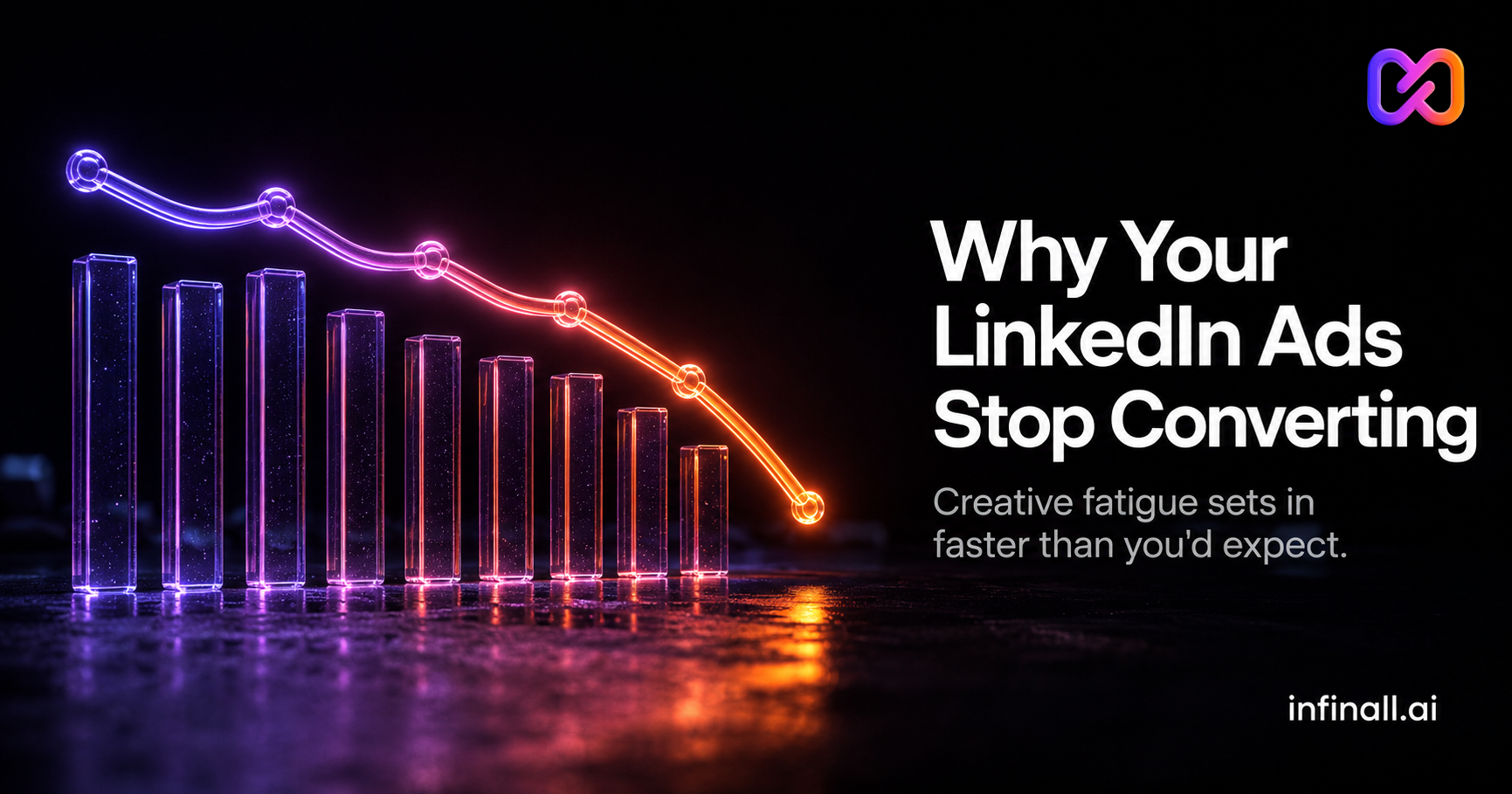
The metrics tell the story clearly if you look for it: impressions holding steady or even increasing, while CTR and conversion rate quietly decline over the same window. That's not a targeting problem. It's the same people seeing the same thing too many times.
Why This Hits B2B SaaS Harder Than Other Categories
B2B SaaS audiences on LinkedIn are often small and specific by design, a particular title, company size, and industry. That specificity is exactly what makes LinkedIn valuable for targeting decision-makers, and exactly what makes fatigue set in faster than it would on a broader consumer platform.
A campaign targeting Demand Gen Managers at Series A SaaS companies in a specific vertical might only have a few thousand people in that audience total. Running the same three ad variations against that pool for two months means a meaningful share of them have already seen everything you're showing, more than once.
The Real Cost of Ignoring It
The instinct when CTR drops is often to blame the offer, the landing page, or the targeting settings, none of which caused the actual problem. Chasing the wrong fix wastes budget and time while the real issue, stale creative, sits untouched.
Meanwhile, cost per lead climbs steadily as the platform's algorithm deprioritizes an ad that's no longer earning engagement, compounding the problem. A campaign that was profitable in week two can become genuinely unprofitable by week nine, purely from fatigue, with the underlying strategy never having been wrong at all.
How to Actually Spot It Before It Costs You
The clearest signal is frequency, how many times on average the same person has seen your ad, tracked against CTR over the same period. A steadily rising frequency paired with a steadily falling CTR is close to a definitive fatigue signal, distinct from a genuine targeting or messaging problem.
Checking this on a two-week cadence, rather than only reacting once performance has already visibly collapsed, catches the decline while there's still time to refresh before the budget gets wasted on a tired creative.
What a Real Refresh Actually Requires
A genuine refresh means new visuals, new copy angles, or both, not just swapping a headline word or changing a button color. Surface-level tweaks rarely reset fatigue in any meaningful way, since the underlying creative concept the audience has already seen repeatedly stays essentially the same.
This is also where the actual bottleneck usually shows up for lean teams. Producing a genuinely new creative angle, new copy, a new visual treatment, sometimes new motion, takes real production time, and a one-to-four person marketing team rarely has a dedicated motion designer sitting around to turn a fresh concept into a launch-ready asset on short notice.
Rotate Angles, Not Just Assets
A stronger long-term approach treats creative refresh as rotating between genuinely different angles on the same core message, a customer proof point this month, a specific pain point next month, a direct product demo after that, rather than producing variations that are visually different but conceptually identical.
This keeps the audience engaged with new ideas, not just new colors, and it tends to extend a campaign's useful life well past the point where a simple visual swap would have stopped working.
Build Refresh Into the Campaign Plan From Day One
Waiting until CTR has already dropped to start thinking about a refresh means scrambling under pressure, often producing something rushed. Planning a refresh cadence upfront, a new creative angle ready roughly every 45 to 60 days before fatigue typically sets in, keeps campaigns performing steadily instead of lurching between strong launches and quiet declines.
For a lean team without in-house motion or design capacity, this is exactly the kind of ongoing production need that eats disproportionate time relative to team size. infinall is built around producing that full next creative round, strategy, copy, and motion video included, from your product and competitor context, so a refresh doesn't mean pulling someone off another campaign for a week to get it done.
FAQs
How long do LinkedIn B2B SaaS ads typically perform before fatiguing?
Commonly somewhere between 60 and 90 days, though narrower audiences can fatigue faster, sometimes within a month.
What's the clearest sign of creative fatigue versus a targeting problem?
Rising frequency paired with declining CTR over the same period, with no change to targeting or offer, points strongly to fatigue rather than a targeting issue.
Does changing just the headline fix creative fatigue?
Rarely. A genuine refresh usually needs a new visual or conceptual angle, not a small copy tweak on the same underlying creative.
How often should B2B SaaS marketers plan creative refreshes?
Roughly every 45 to 60 days is a reasonable planning cadence for most LinkedIn campaigns targeting narrow B2B audiences.
Why does LinkedIn fatigue faster than platforms like Meta for B2B?
B2B audiences on LinkedIn are often smaller and more specific by design, so the same people see repeated creative sooner than on broader consumer platforms.
What should a lean marketing team do without a dedicated motion designer?
Plan refresh cycles in advance and use tools or resources that can produce launch-ready creative, including motion, without needing a full in-house design hire.
Should the whole campaign be paused when fatigue sets in?
Not necessarily. Often just the creative needs refreshing while targeting, offer, and overall strategy can stay the same if they were working.